Your element reading
Your sign appears here
Choose a birthday to see how your zodiac animal connects with the five elements.
The five elements, or Wu Xing, are one of the most important ideas in Chinese cosmology. Wood, Fire, Earth, Metal, and Water are not just physical substances. They are dynamic modes of change. In astrology, they add texture to the zodiac by describing how a person grows, reacts, organizes, protects, and connects.
Wu Xing is easier to understand as a wheel than as a list. Wood feeds Fire, Fire creates Earth, Earth bears Metal, Metal enriches Water, and Water nourishes Wood. The circle shows movement; the inner star suggests how the elements also restrain and balance one another.
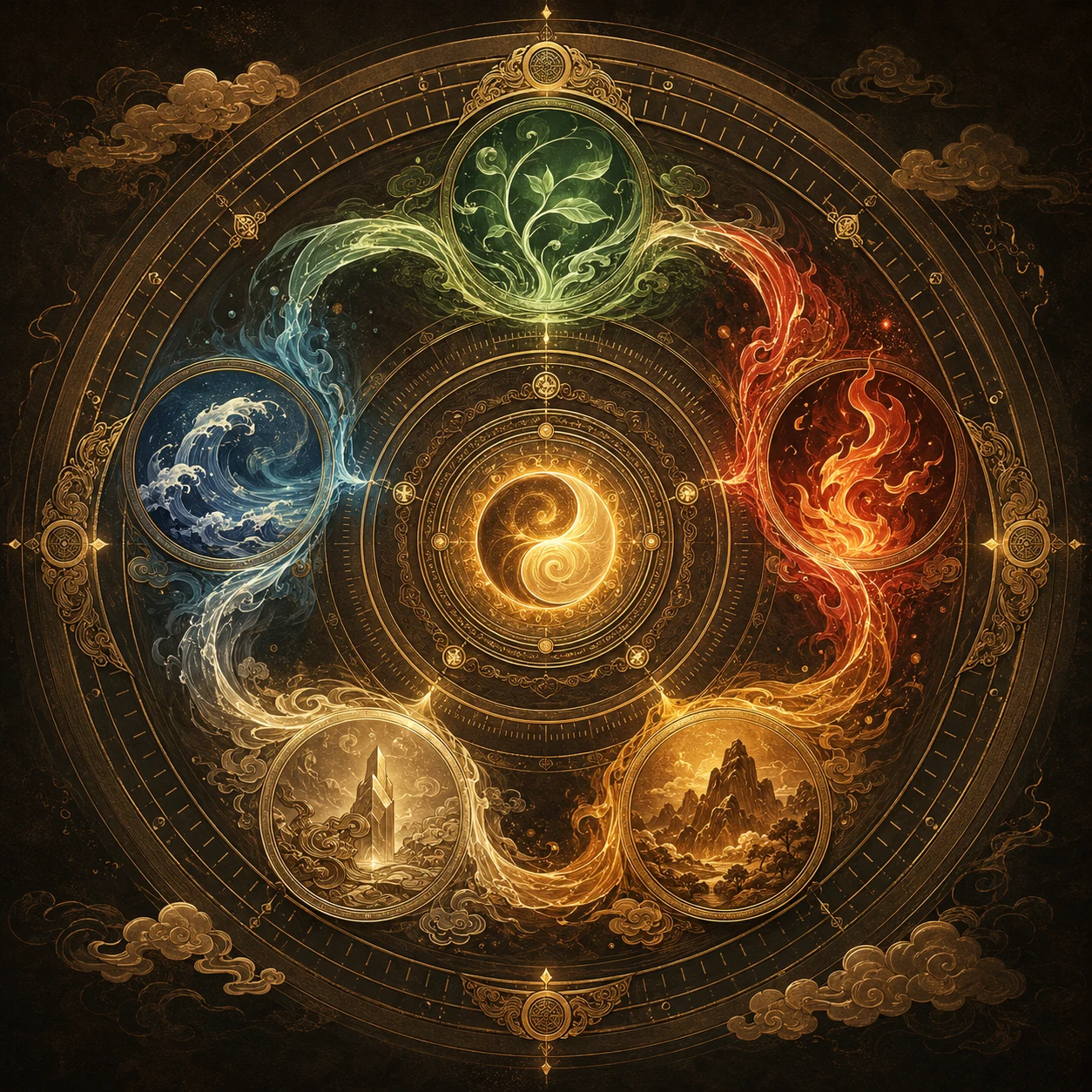 木Wood
火Fire
土Earth
水Water
木Wood
火Fire
土Earth
水Water
Enter your birthday to connect the Wu Xing idea back to your own Chinese Zodiac sign. January and early February dates are checked against the lunar-year boundary.
Choose a birthday to see how your zodiac animal connects with the five elements.
Two people may both be born under strong signs, but the way they express that strength can differ dramatically. Elemental interpretation explains why. Fire may intensify charisma and urgency. Water may deepen intuition and flexibility. Earth may stabilize emotional expression. Without the elements, zodiac reading can feel flat. With them, it becomes more psychologically believable.
Wood grows outward. It is associated with vision, expansion, generosity, and movement toward possibility. Wood-heavy personalities often crave growth and dislike stagnation.
Fire rises and radiates. It is linked to passion, visibility, expression, excitement, and the urge to act. Fire brings charisma, but can also bring volatility.
Earth stabilizes and contains. It symbolizes patience, reliability, nourishment, and grounded presence. Earth can create safety, but too much may become rigidity.
Metal clarifies and refines. It represents precision, discipline, standards, and emotional restraint. Metal can produce excellence, but it may also produce sharp criticism.
Water adapts and penetrates. It is associated with intelligence, intuition, secrecy, and emotional depth. Water can be profoundly perceptive, though sometimes elusive.
Traditional theory describes relationships between elements through cycles. In the generating cycle, Wood feeds Fire, Fire creates Earth, Earth bears Metal, Metal enriches Water, and Water nourishes Wood. In the controlling cycle, one element restrains another to preserve balance. These cycles are part of what makes compatibility readings feel layered instead of random.
For relationship interpretation, this means two people may not simply be "good" or "bad" together. They may support each other, overheat each other, exhaust each other, or bring missing balance.
Elements shape emotional tempo. Fire and Water may create fascination and friction at the same time. Earth and Water may produce soothing support, but also dependency if boundaries are weak. Metal and Wood often create tension between structure and growth. The point is not to fear contrast. The point is to understand it.
When you read a compatibility result on Eastern Affinity, the element note is there to give context to the emotional chemistry. It helps explain why two signs that look promising on a chart can still challenge each other in practice, or why a supposedly difficult pair may still feel magnetic and alive.
If you want to keep going, the best next step is to compare element theory with a compatibility chart and then read a specific sign match. That sequence gives you symbolism, structure, and real examples.
Read the compatibility chart, learn the traditional match rules, or run the compatibility test.